Why Free QR Code Generators Deactivate Your Codes (And What To Do)
Free QR code generators deactivate codes after 14 days, leaving dead codes on printed materials. Real user reviews, platform tactics, and how to avoid the trap.
Most "free" QR code generators are actually 7-14 day trials. After the trial, your codes go dead unless you pay $120-200 per year. QR Code Generator by Egoditor has a 1.5 out of 5 on Trustpilot across 9,198 reviews, almost all about this exact problem. If you already printed business cards, menus, or packaging with one of these codes, you are the business model.
A small business owner creates a QR code on a platform that says "free." She prints it on 500 business cards, 200 flyers, and a roll-up banner for her booth at a weekend market. Four days later, she gets an email: pay 144 pounds per year, or your codes go dead.
She's not imagining this. She left a Trustpilot review about it. So did thousands of other people.
Key takeaways:
Many "free" QR code generators are actually 14-day trials that deactivate codes after expiry. Your QR code will stop working after the free trial ends unless you pay.
QR Code Generator (Egoditor) has a 1.5/5 Trustpilot rating across 9,198 reviews, mostly about deactivated codes.
Uniqode's support team confirmed in writing that ending a subscription means deactivating codes.
The "wait and scan" test (create a code, wait 15 days, scan it) prevents every story in this article.
Below: the tactics these platforms use, real complaints from people who got caught, and what you can do about it. The QR code generator reviews on Trustpilot and Reddit tell a consistent story that pricing pages leave out. We reviewed complaints on Trustpilot, Reddit, Capterra, PissedConsumer, and SiteJabber across five platforms between January and March 2026. FreeQR publishes this analysis, and we compete with some platforms named here. All complaints are sourced from third-party review sites with direct links. For a side-by-side comparison of what platforms actually charge, see Are QR Codes Free? What You Actually Pay For.
The pitch versus the reality
The sign-up page says "free." Sometimes it says "free QR code generator" right in the domain name. You create a code, scan it, and it works perfectly. Nothing on the page hints that you're on a clock.
A QR code trial trap is when a platform advertises its service as "free," lets users create and print dynamic QR codes during a short trial period (typically 7-14 days), and then deactivates those codes unless the user pays for a subscription. The user discovers the terms only after investing in printed materials.
The terms of service tell a different story. Buried in the fine print, you'll find that "free" means a 14-day trial. The code you just created has a clock on it. But nothing in the sign-up flow, the dashboard, or the confirmation email mentions that clock until it runs out.
This gap between the sign-up page and the terms of service is where the money gets made. The platform knows you'll print. And once you've printed, you're locked in. The subscription isn't optional anymore. It's ransom for the materials you've already paid for.
How the trial trap works, step by step
This is not an edge case. This is the business model. Here's how it plays out.
Step 1. You search "free QR code generator." The top results look legitimate. The pages say "free." You pick one.
Step 2. You create a dynamic QR code. It works immediately. You scan it, it loads, everything checks out. Nothing about a trial. Nothing about a deadline.
Step 3. You print. Business cards, menus, flyers, packaging, stickers. You commit real money to physical materials that carry this code.
Step 4. Somewhere between 4 and 14 days later, an email arrives. Your "free trial" has ended. Your codes have been deactivated. To reactivate them, pay the annual subscription.
Step 5. You're stuck. The codes are on printed materials that are already distributed. You either pay a subscription you never agreed to, or you eat the cost of reprinting everything.
Reprinting 10,000 flyers costs roughly $500. Relabeling product packaging can run up to $50,000 depending on production scale (Uniqode, 2025). And the reprint cost is only the financial side. There's also the trust damage: dead codes sitting on materials in people's hands, leading scanners to an error page, and making your business look neglected or broken.
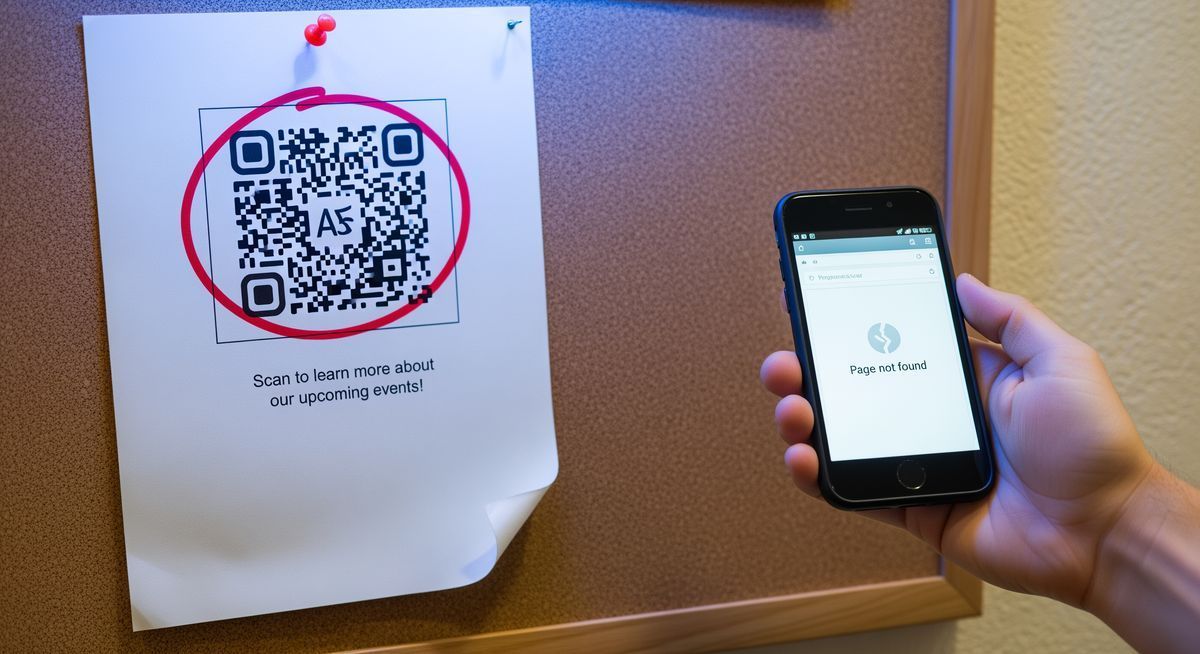
It happens everywhere. Wedding invitations with dead codes glued inside. Resumes where the QR leads to an error page. Laminated menus from last week that now scan to nothing. The people hit hardest are the ones who chose "free" because they had no budget for anything else.
What real users say
Here's what people actually wrote.
QR Code Generator (qr-code-generator.com): 1.5 out of 5 on Trustpilot, 9,198 reviews
"Spent hundreds on creating banners, business cards and flyers for my business only to receive an email 4 days later saying that I either pay a £144 yearly subscription or my QR Codes will not be scanned and invalid."
"Generated a 'free' code for me which I printed to send to wedding guests. Then a few weeks later the code had been deactivated and could only work if I paid their 150eur annual subscription fee!!"
"Secret Pricing! I created a qr code and used it in my CVs. After 14 days (and without being informed!!!) the trial ended and all qr codes are not working anymore so you're forced to pay."
These are not outliers. This is the dominant theme across 9,198 reviews. The platform holds a 1.5 out of 5, one of the lowest ratings of any SaaS product on Trustpilot.
Reddit: r/smallbusiness, March 2025
"I am completely and utterly mentally defeated... the subscription is $50 a month or $239 a year. I definitely don't have $240 for a stupid QR code."
This user ended up hand-cutting small QR codes at the library and gluing them onto 50 business cards. That's where the "free" QR code landed them.
Reddit: r/graphic_design, July 2023
"They make it impossible to see your codes will be deactivated in 14 days, once you spent all your money on packaging, flyers, designs whatever with the QR code you made."
Reddit: r/qrcode, 2021
"I used a QR code generating website that apparently kills my QR code 15 days after I create it unless I subscribe. I already ordered stickers."
Uniqode (formerly Beaconstac): confirmed in writing
Their support team stated the policy directly: "As a subscription-based service, ending the subscription ends the service. That would mean the deactivation of the QR codes."
At least they're honest about it after the fact. The problem is what happens before: a sign-up flow that says "free" with no mention of a 14-day deadline until it's already passed.
Capterra: QR Code Generator Pro
"Before the trial period ended I paid $220 for a year's subscription. However, when my free trial expired, regardless of what I paid, they disabled my qr code."
Paying before the trial ended did not prevent deactivation. The code was disabled anyway.
QRFY: 7-day trial, $200/year lock-in
"Your code is good for seven days; then it's held hostage until you log in and 'upgrade' your plan for some $200 a year."
One business owner had a QR code on the vinyl wrap of her trailer. It was deactivated the day before installation. She paid $9.99 thinking it was a monthly charge. The actual bill was $129.47 for an annual plan. Customer service was unavailable.
Platform | Trial length | What happens after | Primary complaint source |
|---|---|---|---|
QR Code Generator (Egoditor) | 14 days | Codes deactivated, pay €144/year to reactivate | Trustpilot: 1.5/5 across 9,198 reviews |
QRFY | 7 days | Codes redirect to service page, pay ~$200/year | PissedConsumer, SiteJabber |
Uniqode (Beaconstac) | 14 days | Codes deactivated when subscription ends | Confirmed in writing by support team |
Flowcode | Varies | Codes deactivated on plan downgrade | Trustpilot: 3.6/5 across 36 reviews |
QR Code Creator | 14 days | Codes deactivated; annual billing shown as monthly | SiteJabber, Capterra |
Across these five platforms, the pattern is consistent: advertise as "free," wait until materials are printed, then deactivate codes and demand payment. QR Code Generator's 1.5/5 rating across 9,198 reviews makes it one of the lowest-rated SaaS products on Trustpilot, with code deactivation as the dominant complaint theme. (FreeQR original research, April 2026)
Is your QR code generator safe?
When people search "is QR code generator safe," they usually don't mean safe from hackers or phishing. They mean something more basic: will this code still work next month? Will the platform hold my printed materials hostage?
That's a reasonable thing to worry about. According to Uniqode's 2025 consumer research, 52% of consumers have encountered a dead QR code. And ANA/Emplifi research found that most consumers abandon a brand entirely after just two bad experiences. A dead QR code on your business card or product packaging counts as one of those experiences.
The difference between a safe and unsafe QR code generator comes down to one question: what happens to your codes if you stop paying? On platforms like QR Code Generator (Egoditor), QRFY, and Uniqode, canceling your subscription means your codes stop working. On platforms with genuine free plans, codes remain active permanently because the free tier is not a trial.
The business loses a potential customer. The person who scanned decides the brand is sloppy. Nobody involved caused the problem. The platform's pricing model did.
Before committing anything to print, ask three questions:
Is this a free plan or a free trial? Look for the words "free forever" or "free plan" on the pricing page. If the page just says "start free" or "get started free," check the terms of service for the word "trial."
What happens to my codes if I stop paying? Search "[platform name] QR code deactivated" on Google. If you find Trustpilot reviews and Reddit threads describing exactly that, you have your answer.
Does the platform require a credit card to sign up? If yes, there is almost certainly a trial period attached. A genuine free plan does not need your payment details.
For the full breakdown of what 10 major platforms actually offer for free, see Are QR Codes Free? What You Actually Pay For.
What to do if you're already trapped
If your codes are already dead
The codes can't be recovered without paying the original platform. You have two options.
Option A: Pay the subscription. If the cost of the subscription is less than the cost of reprinting, this may be the practical choice. Just know that you'll be paying it for as long as those printed materials are in circulation.
Option B: Reprint on a reliable platform. Create new codes on a platform with a genuine free plan (not a trial), and reprint only the materials that matter most. Start with anything customer-facing: business cards, packaging, signage. Internal documents and old flyers can be phased out gradually. This time, use the "wait and scan" test described below before sending anything to the printer.
If your codes are still active but you're on a trial
You have a narrow window. Act before the trial ends.
Create replacement codes on a platform with a permanent free plan.
Test the new codes on multiple devices before printing.
Update your designs with the new codes.
Print a small batch first and scan-test after the original trial period would have ended.
The "wait and scan" test
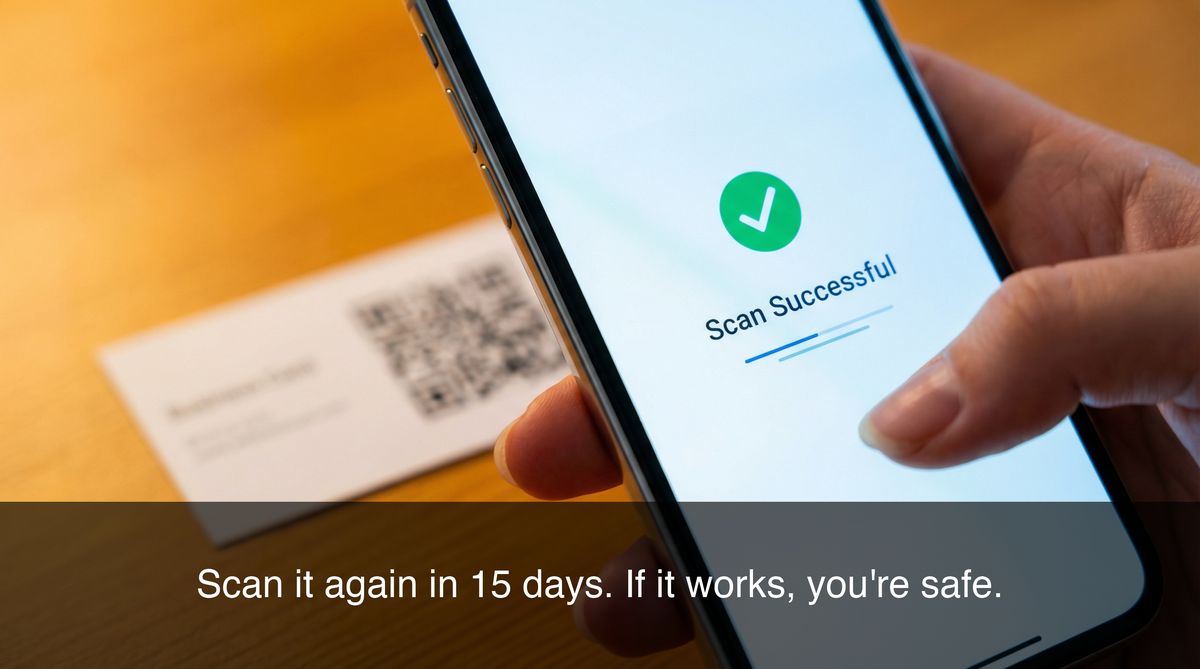
Before committing to any large print run on any platform, do this: create a code, wait 15 days, and scan it again. If it still works after 15 days without payment, you're on a genuine free plan. If it's dead, you just saved yourself a reprint bill.
This one test would have prevented every story in this article. It costs nothing and takes 15 days. If the code still works without payment after 15 days, the platform has a genuine free plan. If it redirects to a payment page or shows an error, that platform will deactivate your codes after printing.
For more on why QR codes stop working and how to prevent it, see Do QR Codes Expire? What Happens After You Print.
A note on fairness: Not every platform that offers a trial is acting in bad faith. Trials are a legitimate business model. The issue is transparency. If a platform clearly labels the trial period, warns you before deactivation, and makes the terms visible during sign-up (not just in the ToS), that's a fair deal. The platforms called out in this article are the ones where users consistently report finding out about the trial only after their codes are already dead.
FAQ
Can I trust a QR code generator?
Some, yes. Others, no. The issue is not security or malware. It's whether the platform will keep your codes active after a trial period ends. Platforms with a genuine free plan (not a free trial) are safe bets. Check Trustpilot reviews and look for the words "free forever" on the pricing page before creating codes you plan to print.
What are the risks of a QR code generator?
The biggest risk is code deactivation after a trial period. You create a code, print it on materials, and the platform deactivates it when the trial ends. You're then forced to either pay a subscription or reprint everything with a new code. Secondary risks include scan caps (your code stops working after a certain number of scans) and platform shutdowns.
Why did my QR code stop working?
Three common reasons. First, the platform deactivated it because your free trial ended. Second, the code hit a scan cap on a free tier. Third, the destination URL itself is broken (the website it points to went down). For dynamic codes, the platform controls whether the redirect stays active. For static codes, the code itself is permanent, but it only works if the URL it encodes still exists. See Do QR Codes Expire? for the full breakdown.
Is there a free QR code with no subscription?
Yes. Several platforms offer dynamic QR codes on genuine free plans with no trial period and no subscription required. The key is to distinguish between "free plan" (permanent) and "free trial" (temporary). FreeQR offers unlimited dynamic codes on its free plan with no scan caps, no trial period, and no credit card required.
What happens to my QR codes when a free trial ends?
On most platforms, dynamic QR codes created during a free trial are deactivated the moment the trial expires. The code still exists physically on your printed materials, but scanning it leads to an error page or the platform's own upgrade prompt. Static QR codes are not affected because they encode the destination URL directly and don't route through the platform's servers.
Can I reactivate a deactivated QR code?
Yes, but only by paying the platform's subscription fee. Most platforms keep your account and codes on file specifically so you can reactivate by upgrading. This is by design. The alternative is creating a new code on a different platform and reprinting your materials. If the reprint cost is lower than the annual subscription, reprinting is the better long-term choice.
Will my QR codes still work if I cancel my subscription?
On most platforms, no. Dynamic QR codes route through the platform's servers, and canceling your subscription means the platform stops handling those redirects. Your codes become dead links. This applies even if you paid for months or years before canceling. The codes are not yours. They are leased for the duration of your subscription.
Already dealing with dead QR codes from a trial-based platform? FreeQR has a free plan with unlimited dynamic codes, no scan caps, and no credit card required. Codes stay active whether you pay or not.