Subscription Fatigue Is Real. Some Tech Companies Are Listening.
Subscription fatigue is driving a freemium comeback in SaaS. FreeQR explores the data, which companies are winning with free tiers, and what it means for QR codes.
The average U.S. household went from 4.1 paid subscriptions to 2.8 in 2025. That is a one-third drop in a single year, according to a Self Financial survey reported by Vice. The headline captured the mood: "The Subscription Era Is Over. The Purge Has Begun in America."
Subscription fatigue is not a media narrative. It is a measurable shift in how consumers spend. And it is forcing a question that a lot of tech companies avoided for years: what if your business model depends on people forgetting to cancel?
Some companies are responding by doubling down on retention tricks. Others are doing something more interesting. They are giving their products away for free and making more money than the companies that charge from day one.
Key takeaways:
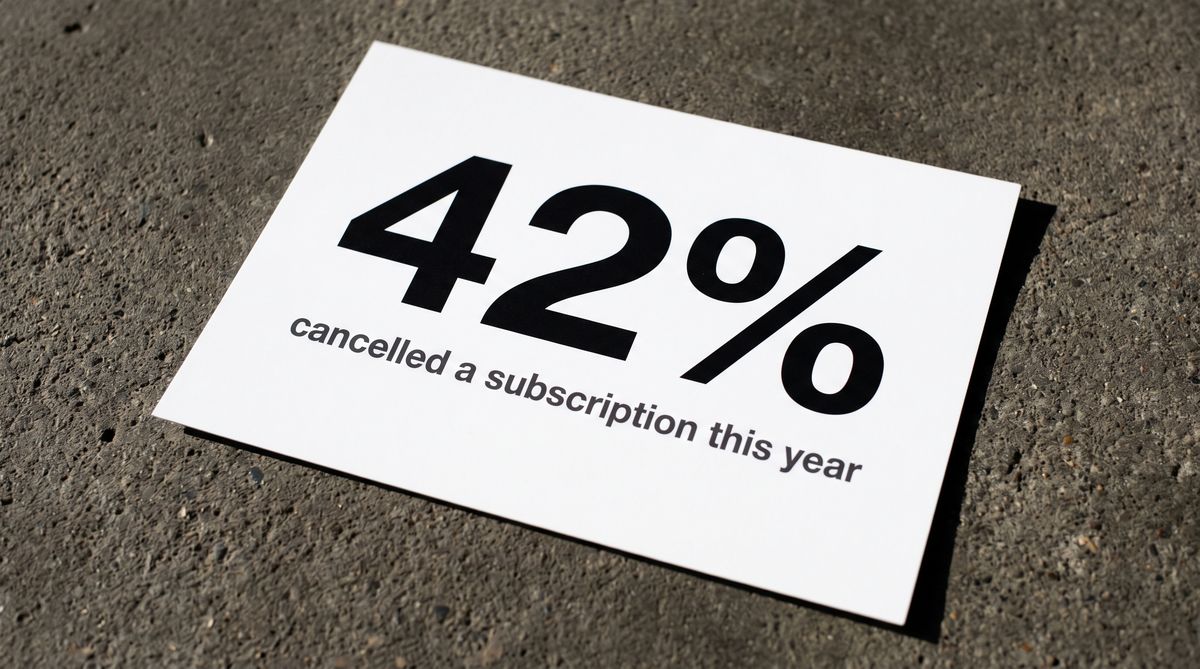
42% of U.S. consumers cancelled at least one subscription in the past six months (CivicScience, 2025).
Forced converters (auto-billed after trial) have roughly 45% churn within 60 days. Committed converters churn 70% less (ChurnAnalyzer).
Canva, Figma, Slack, and Notion all built billion-dollar businesses on a freemium model where the core product is free.
The QR code industry still relies heavily on trial-and-deactivate pricing. The backlash is visible in review scores.
The numbers behind subscription fatigue
Subscription fatigue is the growing consumer tendency to cancel recurring digital services due to accumulated cost, redundancy, or perceived low value. And it is accelerating.
A CivicScience survey of 4,800 U.S. consumers in late 2025 found that 42% had cancelled at least one subscription in the past six months. More than half cited "declining perceived value relative to the subscription fee" as the reason. Not financial hardship. Perceived value. People are not broke. They are fed up.
Deloitte's 2025 Digital Media Trends survey found that 47% of consumers had cancelled streaming services alone. The average American adult spends $91 per month on subscriptions (CNET, 2024). And 93% say they are more aware of that spending than a year ago (Recurly, 2025).
Regulators have noticed. The FTC's Click-to-Cancel rule, effective in 2025, requires companies to make cancellation as easy as sign-up. California's updated Automatic Renewal Law now mandates annual reminders before auto-renewals. Minnesota prohibits "save" offers during cancellation. In October 2025, 33 states reached a $4.8 million settlement with TFG Holding over allegations of enrolling consumers in subscriptions without clear consent.
The pattern is clear. Consumers are cancelling. Lawmakers are legislating. And companies that depend on inertia rather than value are losing ground.
What happens when companies force the conversion
There is a difference between a customer who chose to pay and one who forgot to cancel. The retention data makes it obvious.
Research from ChurnAnalyzer breaks it down:
Conversion type | 60-day churn rate | Long-term retention |
|---|---|---|
Forced converters (auto-billed after trial) | ~45% churn | Low |
Committed converters (chose to upgrade) | ~70% less likely to churn | High |
Forced converters stay for weeks. Committed converters stay for years. Auto-billing someone after a trial does not create a customer. It creates a cancellation in progress.
One SaaS company that switched from a trial model to a freemium model saw monthly churn drop from 4.2% to 3.1% (CloudMetrics case study). That single percentage point compounds. Over twelve months, it is the difference between replacing a third of your user base and keeping most of it.
Rob Walling, author of The SaaS Playbook, notes that only 17% of SaaS products maintain a freemium tier. But the ones that do tend to punch above their weight in revenue. The math works because a large free user base, even with a low conversion rate, produces real recurring revenue from the people who voluntarily upgrade.
The freemium comeback
The freemium business model is a pricing structure where a product's core features are permanently free, with optional paid tiers for advanced functionality. It fell out of fashion in the early 2010s when VCs pushed SaaS companies toward higher average revenue per user. But the biggest product-led growth stories of the last decade all used it.
Company | Annual revenue (2025) | Free tier scale | How free drives paid |
|---|---|---|---|
Canva | $3.5B ARR | 260M monthly active users | Unlimited free designs. Paid tiers for teams and premium assets. |
Figma | $600M+ ARR | 4M+ users | Free for individuals. Employers become enterprise accounts. |
Slack | Not disclosed | 80% of paid workspaces started free | One employee adopts it, then a team, then the org pays for admin controls. |
Notion | Enterprise contracts ($100K-$1M+) | 100M+ users | Personal plan free forever. Spreads through recommendations into enterprise deals. |
Sources: Aakash Gupta (product growth analyst) for Canva; company reporting for Slack; public reporting for Figma and Notion.
What these companies share is a willingness to let people use the product without paying. Sometimes for years. The theory is simple: good software sells itself. None of them needed expiring trials to generate revenue.
Freemium works because it matches how people actually buy things. Give someone a product that solves a real problem. Let them build habits around it. Let them recommend it to colleagues. When they eventually need more, whether that is team features or analytics or admin controls, they upgrade because the product already proved itself. Not because a trial clock ran out.
Canva grew more than 40% year over year in 2025. Slack's path from free team to paid enterprise workspace became a textbook example. Notion turned individual adoption into six- and seven-figure enterprise contracts through the same bottom-up motion.
Give the product away. Let it spread. Monetize the power users.
This is not charity. It is a distribution strategy. Every free user is a potential referral. A shared design, a forwarded workspace invite, a template recommendation: each one is organic marketing that a trial-gated product never generates. The companies on that list spend less on paid acquisition per dollar of revenue than their trial-dependent competitors because their users do the selling for them.
What this means for QR codes
The QR code industry, valued at $13 billion and projected to reach $33 billion by 2031 (Mordor Intelligence), has not caught up to this shift.
Most QR code platforms still run the trial-and-deactivate model. You get 7 to 14 days of full access. You create dynamic codes and print them on packaging or menus. Then the trial expires and the codes stop working. The printed materials become waste.
Three of ten major platforms deactivate codes after a 14-day trial. QR Code Generator, one of the largest platforms in the space, has a 1.5 out of 5 rating on Trustpilot across 9,198 reviews. The complaints follow a pattern: signed up for "free," printed materials, got the deactivation email, discovered the subscription was the price of keeping their own codes alive.
The stakes in QR codes are higher than in most SaaS categories. Cancel a project management tool, your work is inconvenienced. When a QR code is deactivated, printed materials carrying that code become physical waste. A restaurant with dead codes on its menus. A manufacturer with non-functional codes on 10,000 labels. The cost is not a monthly fee. It is a reprint.
This is the exact practice that subscription fatigue is a reaction against. A streaming service you can replace in five minutes is one thing. A QR code printed on 10,000 product labels is something else. You cannot switch providers without reprinting.
For a deeper look at how these trial traps work and what real users have experienced, see The Hidden Costs of "Free" QR Code Platforms.
The irony is that QR codes are a natural fit for freemium. A dynamic QR code that routes through your servers is a permanent touchpoint. Every scan is a data point. Every working code is a reason for the user to stay on your platform. Deactivating a code after 14 days does not create urgency. It creates resentment and one-star Trustpilot reviews.
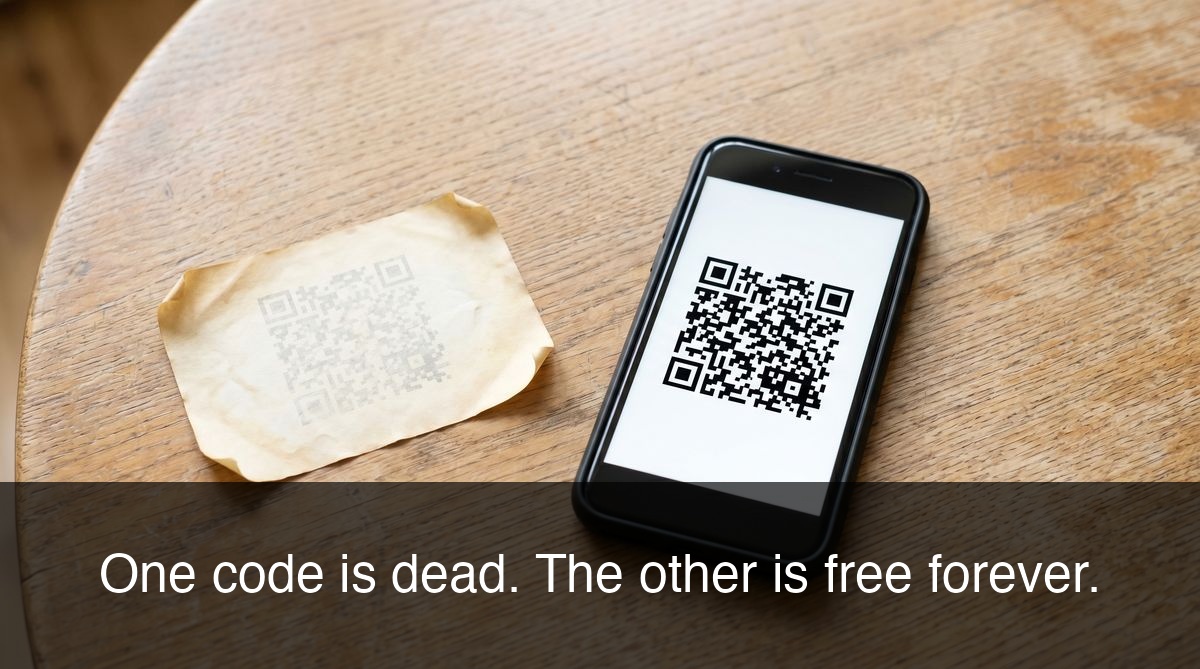
Why "free forever" works for QR codes
A free QR code that keeps working is marketing. Each scan connects the user back to the platform that created it, and each working code is a reason to come back and make another one.
Freemium in QR codes works the same way it works for Canva or Slack. A small business owner creates a free dynamic code for their menu. It works. They create another one for their business card. That works too. Six months later, they need scan analytics for a campaign, or a branded landing page, or team management. They upgrade because the free product already proved itself.
This is how FreeQR is built. Dynamic QR codes on the free plan stay active permanently. No credit card. No deactivation deadline. No expiration clock. Paid tiers exist for power features like advanced analytics, custom landing pages, and team collaboration. The bet is the same one Canva and Figma made: if the free product genuinely works, some users will pay for more on their own terms.
Freemium is not a silver bullet. It requires a product good enough to keep users without charging them, and unit economics that can absorb a large free tier. Not every company can pull this off. But in QR codes, where the product is lightweight, the marginal cost per user is low, and the switching cost after printing is high, the case is strong.
The companies still running trial traps are not competing against free alternatives. They are competing against consumers who have already learned to cancel first and evaluate later. The smartest move is to never give someone a reason to cancel in the first place, by never forcing them to pay.
Frequently asked questions
What is subscription fatigue?
Subscription fatigue is the growing consumer tendency to cancel, consolidate, or avoid recurring digital subscriptions due to accumulated cost, redundancy, or declining perceived value. A 2025 CivicScience survey found that 42% of U.S. consumers had cancelled at least one subscription in the past six months.
Are people getting tired of subscriptions?
Yes. The average U.S. household dropped from 4.1 paid subscriptions to 2.8 in 2025 (Self Financial/Vice). Deloitte's 2025 survey found 47% had cancelled streaming services. The FTC's Click-to-Cancel rule and new state-level legislation reflect a regulatory response to the same trend.
What is a freemium business model?
A freemium business model is a pricing structure where a product's core features are permanently free, with optional paid tiers for advanced functionality. Companies like Canva ($3.5B ARR), Figma, Slack, and Notion use this model, letting free users drive adoption and converting a percentage to paid plans over time.
Why are companies going back to free?
Because forced conversions produce high churn. Research shows auto-billed trial users churn at roughly 45% within 60 days, while users who chose to upgrade churn 70% less. Companies are finding that a large, engaged free user base with a small conversion rate generates more sustainable revenue than a smaller base of reluctant subscribers.
What is the difference between freemium and subscription?
A subscription model charges users a recurring fee to access the product, often starting with a free trial that auto-converts to paid. A freemium model gives permanent free access to core features and charges only for premium upgrades. The key difference is that freemium users never lose access to basic functionality, while subscription users lose access when they stop paying or when a trial ends.
Written by Andy Lee, QR Technology Specialist at FreeQR. FreeQR helps people create dynamic QR codes with built-in landing pages and scan analytics. Learn more about us.